Self-Harm Awareness for Trauma Survivors, Including Sex-Trafficking Survivors

By Viviana Sanchez

What is self-harm?

Self-harm is a misunderstood phenomenon that is heavily prevalent in adolescents and young adults, with an estimated lifetime incidence of 16.9% (Gillies et al., 2018). The numbers increase significantly for victims of sex trafficking, where rates of self-harm have been reported as high as 33% (Borschmann et al., 2017).

Self-harm is intentional harm to one’s own body. It can look like, but not be limited to, behaviors like cutting or burning, but it is distinct from suicidal behavior because there is not necessarily an intent to die.

At first, it might be difficult to understand why someone would engage in self-harm. However, there is a deeper emotional reason. For many, self-harm becomes a way to cope with overwhelming negative feelings, unresolved trauma, or a coping mechanism that serves to regain a sense of control over one’s body. This is important to consider for sex trafficked survivors because they experience exploitation, and their sense of autonomy is taken away.

There are also harmful misconceptions about people who self-harm. One belief is that it is an attention-seeking behavior. However, most people will go to great lengths to hide it by covering their bodies and avoiding situations where people might notice. Rather than assuming self-harm is purely about attention-seeking, a more helpful way to think about it is as a signal for help and an opportunity to offer support instead of judgment (Caicedo & Whitlock, 2009).

Another misconception related to self-harm is that it is primarily associated with certain groups, like alternative subcultures (e.g., gothic, emo; Caicedo & Whitlock, 2009). People who self-harm come from all backgrounds, from all socioeconomic levels, from every profession in between, and from all communities.

A final harmful perception is that all individuals could stop if they really wanted to (Caicedo & Whitlock, 2009). Though for some, self-harm could develop into a pattern that feels addictive. So, for these reasons, it is imperative that we support and advocate for our loved ones who may be struggling with self-harm.
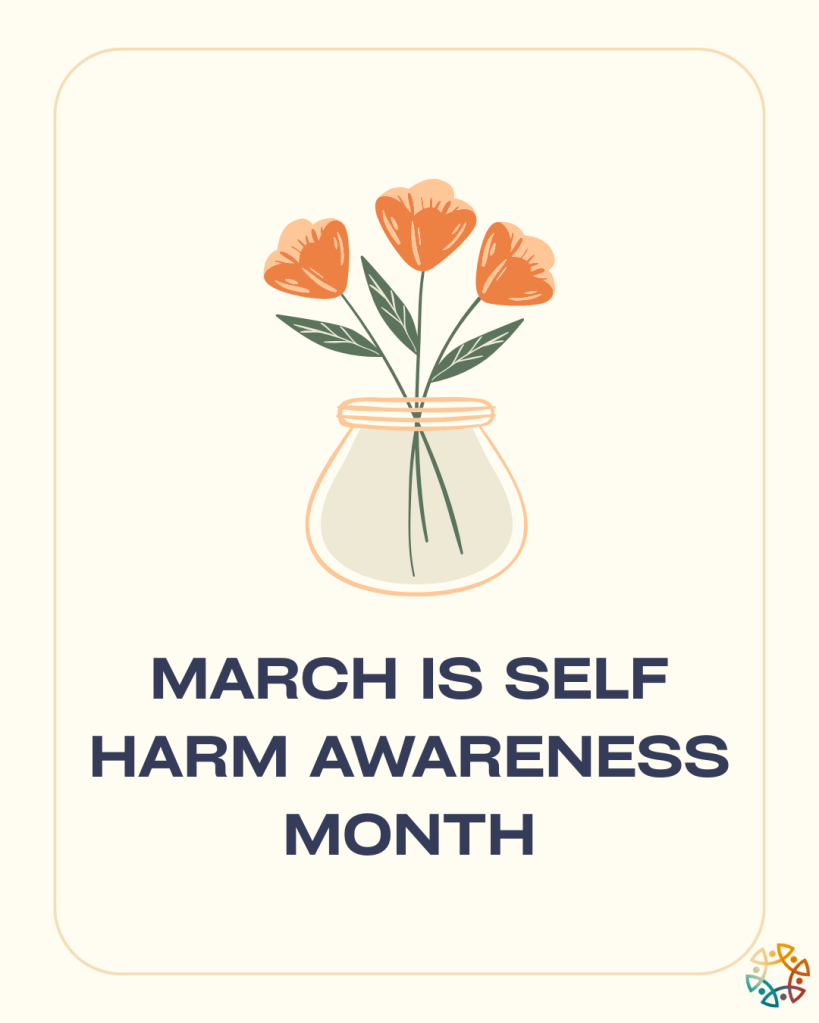
View and share our post on social media @castresearch.

Why It Matters

For self-harm awareness month, this blog addresses the struggles and stigma of self-harm, including those among survivors of sex trafficking. Survivors experience coercion and loss of control over their bodies. Self-harm can emerge as a way to regain control or express pain that survivors are unable to put into words. Stigma and misunderstanding can make healing more difficult and prevent people from seeking help. Spreading awareness and showing compassion are ways advocates can help reduce stigma and support survivors.

What the research says:

Trauma and self-harm: Researchers found that a history of childhood trauma is positively correlated with self-harm (van Schie et al., 2024).

Complex trauma: Survivors of trafficking experience complex mental health issues, including PTSD, dissociation, and emotional dysregulation, all of which increase vulnerability to self-harm (Brockdorf et al., 2023).

Stigma and healing: Stigma about self-injury has serious psychological consequences. Individuals report experiencing both internalized shame and external judgement, which discourages them from seeking help and makes them also feel further isolated and misunderstood (Lewis et al., 2025).

Compassionate Support & Reflection

If someone you care about is struggling with self-harm, compassionate support is just what they need. In the moment, it might feel difficult to know how to respond, but these small actions can help reduce stigma and create space for healing.

Educate yourself: Learning about self-harm and the role trauma plays will reduce misconceptions.

Listen: If a loved one shares their struggles with you, this is a powerful and underrated response. Try not to rush to fix the problem

Avoid Blaming or Shaming: We want to combat internal shame by responding in a nonjudgmental and compassionate way

Offer Support: People benefit from both personal and professional help, so encouraging professional support as well will give them the best possible support system to overcome their challenges.

Reflection questions:

· What small changes could we make in the way we respond to others that could reduce stigma around trauma and self-harm?

· If someone trusted you enough to talk about their struggles, what kind of response would help them feel heard and supported?

References

Borschmann, R., Oram, S., Kinner, S. A., Dutta, R., Zimmerman, C., & Howard, L. M. (2017). Self-harm among adult victims of human trafficking who accessed secondary mental health

services in England. Psychiatric Services, 68(2), 207–210. https://doi.org/10.1176/appi.ps.201500509

Brockdorf, A. N., Gratz, K. L., Messman, T. L., & DiLillo, D. (2023). Trauma symptoms and deliberate self-harm among sexual violence survivors: Examining state emotion regulation and reactivity as dual mechanisms. Psychology of Violence, 13(1), 23–33. https://doi.org/10.1037/vio0000432

Caicedo, S. & Whitlock, J.L. (2009). Top misconceptions about self-injury. Cornell Research Program on Self-Injury and Recovery. https://www.selfinjury.bctr.cornell.edu/perch/resources/15-misconceptionsenglish-4.pdf

Gillies, D., Christou, M. A., Dixon, A. C., Featherston, O. J., Rapti, I., Garcia-Anguita, A., Villasis-Keever, M., Reebye, P., Christou, E., Al Kabir, N., & Christou, P. A. (2018). Prevalence and characteristics of self-harm in adolescents: Meta-analyses of community-based studies 1990-2015. Journal of the American Academy of Child and Adolescent Psychiatry, 57(10), 733–741. https://doi.org/10.1016/j.jaac.2018.06.018

Lewis, S. P., Collaton, J., Pugh, R. L., Heath, N. L., & Whitley, R. (2025). The lived experience of self-injury stigma and its psychosocial impact: a thematic analysis. BMC psychology, 13(1), 563. https://doi.org/10.1186/s40359-025-02664-6

van Schie, C., Gallagher, R., & Krause-Utz, A. (2024). Exploring the complex relationship between childhood trauma and self-harm. Journal of Aggression, Maltreatment & Trauma, 33(6), 685–703. https://doi.org/10.1080/10926771.2024.2303525
Passion for Advocacy through Research

When COVID hit, I unexpectedly had time to reexamine my career path, and the opportunity to ask myself what I was passionate about. I knew I had always been driven to advocate for others, so I began working as a victim advocate in 2021, supporting survivors of sexual assault and potential or confirmed child exploitation. That role expanded into collaborating with partners across San Antonio to identify and support child survivors of trafficking at a Children’s Advocacy Center. My professional identity was shaped in those spaces through providing direct, hands-on support, while collaborating with others across organizations.

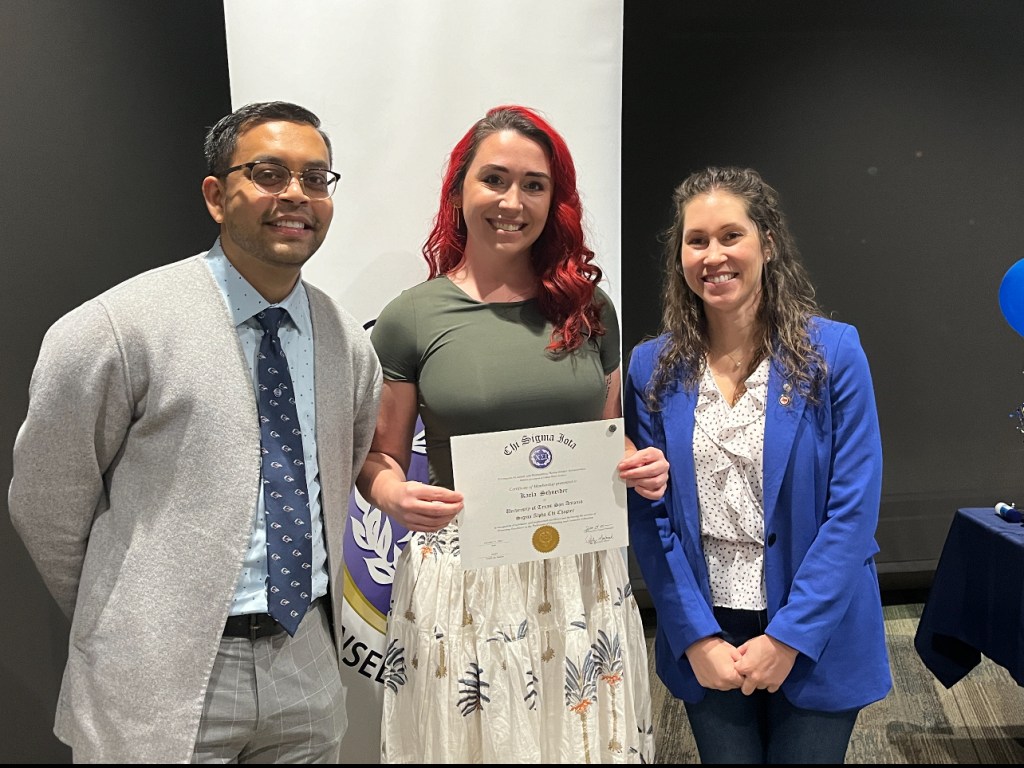
Dr. Harrichand, Kaela, Dr. Romero at induction into Sigma Alpha Chi chapter of Chi Sigma Iota Honor Society

I became passionate because the work was immediate and deeply relational. I responded to crises, supported individuals navigating legal and family systems, and advocated for their needs across multiple systems of care. It was there that I began noticing gaps, including survivors falling through the cracks, feeling invalidated or unheard, and interventions that failed to align with the realities they were navigating. At the time, I understood these gaps through experience and intuition. I did not yet recognize how many existed because the research had not caught up to practice. Witnessing the harm that came from overlooking these populations in mental health care, in particular, led me to pursue a degree that places me on the path toward eligibility for Licensed Professional Counselor licensure.

I entered the Clinical Mental Health Counseling program at UT San Antonio in the spring of 2024 with this strong advocacy identity and a focus on developing my clinical skills. My perspective began to shift through my involvement with the Counselors Against Sex Trafficking (CAST) Research Lab. Early in my program, I completed an advocacy project on sex trafficking that examined prevalence rates in Bexar County, barriers to supportive treatment, and strategies for better serving survivors. Through this work, I was introduced to Dr. Romero and Dr. Interiano-Shiverdecker, two of the founding members of CAST. Working with this team challenged assumptions I did not fully realize I was carrying. I began to see how much of the field relies on research that contains significant gaps in multicultural understanding, particularly in how counselors can effectively support survivors across diverse communities. While identifying these gaps can be straightforward, filling them requires intentional, high-quality research informed by varied backgrounds and lived experiences. Without practitioners contributing back to the research, these gaps persist and continue to shape care in limited ways.

“No research without action, no action without research.” 

– Kurt Lewin

Looking back, research felt like something that belonged to a different world, an academic space disconnected from people’s day-to-day lives. It did not feel attainable or relevant to someone outside the academic environments, particularly as a Veteran and nontraditional student returning to education. I assumed the information already existed and that the gaps I observed were problems of access or implementation rather than evidence. I have since found that research in counseling exists to make sense of lived experience, identify patterns across systems, and help provide education for future counselors to sharpen their skills. It is not separate from practice; it is how counseling becomes sustainable, ethical, and effective beyond any one individual’s effort.

My involvement with CAST represents a full-circle moment in my professional development. As a researcher, I now engage with the same population I once served on the front lines, but through a broader lens focused on training, advocacy, and hopefully systemic change. My work has included editing interview transcripts from counselors, survivors, legal professionals, and law enforcement, as well as coding qualitative data related to counselor support and system response. The themes that emerged closely mirrored my lived experience. Survivors often do not identify their experiences as trafficking, professionals frequently feel underprepared, and systems can unintentionally or intentionally replicate harm. These parallels reinforced my belief that research is a powerful form of advocacy. It bridges the gap between intuition and evidence, and CAST is shaping how counselors are trained and how communities are supported. Rather than replacing my advocacy identity, research has expanded my passion for it, allowing me to translate lived experience into evidence that supports more ethical, trauma-informed care for survivors of sex trafficking.

Written by Kaela Schneider. Kaela is currently completing her MS in Clinical Mental Health Counseling with a projected graduation in August 2026. She plans to continue working with populations impacted by sex trafficking, interpersonal trauma, and substance abuse.

Growing Through Advocacy

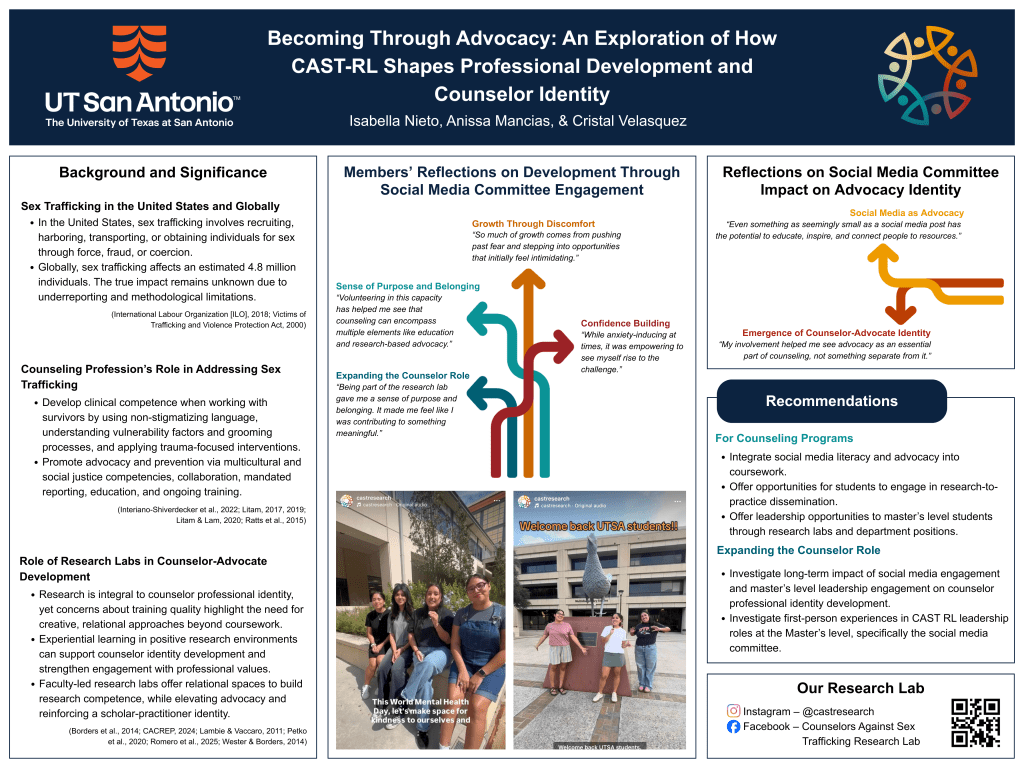
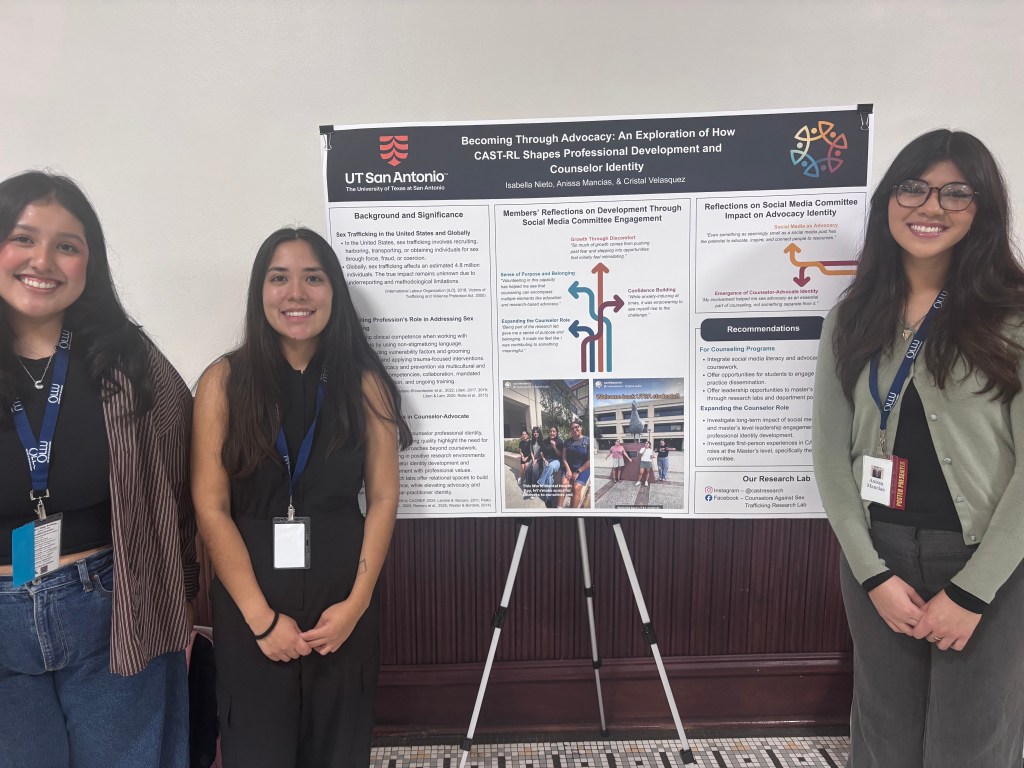
Presenting a poster at a professional counseling conference is a valuable opportunity to engage in scholarly dialogue, and professional development. This year, the social media committee of the Counselors Against Sex Trafficking (CAST) Research Lab had the opportunity to present a poster titled, “Become Through Advocacy: An Exploration of How CAST-RL Shapes Professional Development and Counseling Identity” at the South Central Regional Counseling Association Winter Workshop. We centered our presentation on our experiences in the social media committee, the skills we have developed along the way, and how it is assisting in our professional development.

Poster Development
The development of the poster started well before the conference itself. The committee recognized that serving the CAST Research Lab through this capacity was beneficial towards personal development and wanted to share this value with others. We began by conducting a literature review on the current research regarding the counseling profession’s role in addressing sex trafficking and the role research labs have in supporting counselor-advocate development. Afterwards, we answered reflective questions that focused on our experiences in the social media committee, the skills we have developed, and the benefits and insight we have gained along the way. From there, we consolidated and analyzed the data, noting key themes among our responses.

Findings and Summary
When it comes to member reflection on development through the social media committee, a key theme was confidence-building. One member said, “While anxiety-inducing at times, it was empowering to see myself rise to the challenge.” Another related theme is experiencing growth through discomfort. Another committee member noted that “so much growth comes from pushing past fear and stepping into opportunities that initially felt intimidating.” These two themes dovetail to communicate the personal development from taking on new tasks, engaging with unfamiliar information, and being open to new opportunities. Notably, members shared that sharing information and resources on sex trafficking through social media has had an impact on advocacy identity. One member said, “My involvement helped me see advocacy as an essential part of counseling, not something separate from it.”

The findings from our reflections highlight recommendations for counseling programs and for future research. For the former, to support counselor professional development, especially in research, advocacy, and leadership, counseling programs can offer opportunities for students to engage in research. Existing research labs can offer leadership opportunities to master’s level students through committee positions and assistantships. For future research, it would be impactful to investigate the long-term impact of social media engagement and master’s level leadership engagement on counselor professional development. Further research in this domain would give further insight into how counseling programs can support counselor professional development and confidence.

Personal Reflections
Presenting our poster at a professional counseling conference was an enlightening and affirming experience. Being in a room full of counselors actively addressing the mental health field reinforced a sense of belonging and helped solidify my counselor identity. Sharing our work and engaging in meaningful conversations with professionals who were supportive, curious, and genuinely invested in the growth of future counselors was incredibly fulfilling. It was especially encouraging to be reminded that many of the professionals present were once in the same stage of development that we are in now.


Looking ahead, we are excited to incorporate more data in future presentations to expand the scope and impact of our work, as well as attend more presentations as a group. For master’s students interested in research or presenting at conferences, our biggest advice is to do it scared. Growth happens in uncomfortable spaces, and it is okay to feel nervous or unsure and still move forward. Reaching out to professors, peers, and research labs is worth it, not only for professional development, but for the confidence and counselor identity it helps build along the way.

Written by Bella Nieto, Cristal Velazquez, and Anissa Mancias

Meet the Researcher – Elaine

At the Counselors Against Sex Trafficking Research Lab, one of our primary missions is to mentor and educate the next generation of counselors, counselor educators, and researchers. Elaine is a doctoral Research Assistant in the research lab. Learn more about her and her journey into research at the vlog below.

“I really do feel like even when we are in the midst of a very heavy, very strenuous season of our lives and we are really getting bombarded with really intense things left and right, it’s not just what we are doing now, but what we are doing to set up those next generations of success.”

Elaine Oyoma on what gives her hope

Transcript:

Cristal Velasquez: Hi. My name is Cristal, and this is a part of our segment of Meet the researcher well, where we will be interviewing researchers in the CAST Lab, and they will be telling us a little bit about themselves. 

Today, I have Elaine Oyama, and yeah, so she’s just going to introduce herself and tell us a little bit about herself. 

Elaine Oyama: Hello, everyone. I’m Elaine Oyama. I am an incoming first year doctoral student with the Counselor Education and Supervision program. I just finished out my master’s in Clinical Mental Health Counseling, also at UTSA, this past May. So I am really just sticking through school. I’m about to take my licensure exam to become an LPC associate, and I’m in the process of starting my private practice, Blossom and Bloom Counseling, so that I can serve clients while also being in a doctoral program. 

Cristal Velasquez: What inspired you to get involved in research related to sex trafficking?

Elaine Oyama: I actually became involved in advocacy in general towards especially survivors of sexual assault, human trafficking, child exploitation, when I was think 16 years old. I’m a survivor myself, so I really had to come out of that spiral of depression that a lot of our fellow survivors can go through. And I chose to align myself with advocacy. I started working for the San Antonio Rape Crisis Center back in 2022 and I became the Child Exploitation Human Trafficking Specialist over there after a few months, and ever since, I knew that this is the population that I want to work with. 

It’s something I’m very passionate about, and we all know that there’s not enough research in this field. So I feel very blessed that I get to use not only my own experiences as a survivor, but every experience from survivors I’ve worked with and make sure that the future of our career and the future of every person who works with survivors has the resources that we are creating to make the world a better place. 

Cristal Velasquez: What is something that you’ve learned in your work that has surprised you? 

Elaine Oyama: Honestly, I have been shocked by everything. It’s a matter of there’s a lack of resources, there’s a lack of knowledge, and all of those things can stem together to really negatively impact this very vulnerable population. When all things are going wrong, somehow, this population is still incredibly resilient. Every person that I’ve worked with, all of my clients, everyone that I’ve worked with, just within the field in general, is incredibly passionate about this field, and we all know that there’s a immense lack of resources, but we’re all trying to do our best to make sure that we are building those resources. We’re building those toolboxes for our survivors. So I will never cease to be amazed, but I hope that one day I won’t be as amazed by the lack of resources. 

Critstal Velasquez: And now, could you please tell me about, like, your recent work that you’re working on and your recent research?

Elaine Oyama: I’m currently working on what’s called the CAST INTRA project. So basically, I’ve had the opportunity to interview a few attorneys who, while they might not specifically specialize in sex trafficking cases, they at least have a wealth of knowledge and experience in working with survivors. So I’m handling a bunch of attorneys right now, but a lot of my peers are working with counselors, law enforcement, other members of the justice system, and soon, we’re actually going to be reaching out to survivors directly to learn their stories, learn how they have been impacted by their trauma, and really just see what kind of things that we can do as counselors to improve their treatment. What are the things that they are missing, so that all of these people in all of these different populations and specialties can gain that knowledge, and we as counselors can improve these tools and the resources that we either have or do not have, to build those bridges and fill those gaps.

Cristal Velasquez: Now, could you tell us what’s your favorite way to decompress after a tough research day?

Elaine Oyama: I have recently gotten very into sourdough. It has become, I don’t want to say, a problem, but his name is “Edgar Allan Doe”. He lives on my counter, and he has a few hats that make sure that he’s getting the right air circulation he needs to grow. And I definitely do eat all of the bread that I bake for myself, I try to share. It doesn’t really go well. So sourdough baking and reading recently, I love an audiobook, taking this time in between the masters and doctoral program to decompress while I care. 

Cristal Velasquez: So now, what is your go to coffee order while working on research, like during a stressful day or just in general?

Elaine Oyama: In general, I’m a pretty simple coffee girl. I really love a whole milk caramel latte. And if there’s an option for cold foam, I will always do it, and it has to be ice. 

Cristal Velasquez: Lastly, to wrap up our interview, what gives you hope around doing research in such a heavy topic?

Elaine Oyama:  I like to believe that hope stems from our hopes and dreams for the future. It’s not just what we can do in our current positions, but what generations of counselors, counselor educators, really just the future of our society are going to do. And I really do feel like even when we are in the midst of a very heavy, very strenuous season of our lives, and we’re really getting bombarded with really intense things left and right. It’s not just what we’re doing now, but what we’re doing to set up those next generations for success, to make sure that any person that even 100 years from now that we’re working with is getting access to the best, most comprehensive, holistic form of counseling that they can receive to make sure that we’re actually doing our job, that we’re helping them see that light in the darkest moments of their lives. So I feel very blessed, very honored, to be part of the CAST Lab, and I’m really excited to see what comes next. 

Cristal Velasquez: Hey, guys, that was Elaine Oyama telling us about her experience in the cast research lab.Yeah, we’re hoping for the future. You get to meet more of our researchers, and you become as interested as we are in the research that is being done in the cast lab. Thank you.

Elaine Oyama is an LPC-Associate (supervised by Megan Smith, PhD, LPC-S) an National Certified Counselor (NCC) who earned her M.S. in Clinical Mental Health Counseling from UT San Antonio in May 2025. She is a first-year doctoral student, studying Counselor Education & Supervision. Elaine owns a private practice, Blossom & Bloom Counseling PLLC, and specializes in working with children and adults who have experienced trauma or suicidal ideation. Elaine serves as a Graduate Research Assistant and is currently conducting research with the Counselors Against Sex Trafficking (CAST) Research Lab. She is the current President-Elect of the Sigma Alpha Chi chapter of Sigma Chi Iota.

Cristal Velasquez is currently starting her second year in the Master’s program for Clinical Mental Health Counseling at UT San Antonio. Cristal first became interested in joining the CAST Lab after learning about it in one of her classes. The topic of sex trafficking is especially important to her, as a woman, and she views this work as a meaningful way to advocate for survivors and raise awareness. Cristal is particularly excited about using social media as a platform for advocacy and education. Her career goal is to become a licensed professional counselor, where she hopes to continue empowering individuals while also advocating for broader mental health and social justice initiatives.

To stay updated about our recent projects and lab news, follow us on social media @castresearch.